
COMtable- Count On Me Table.
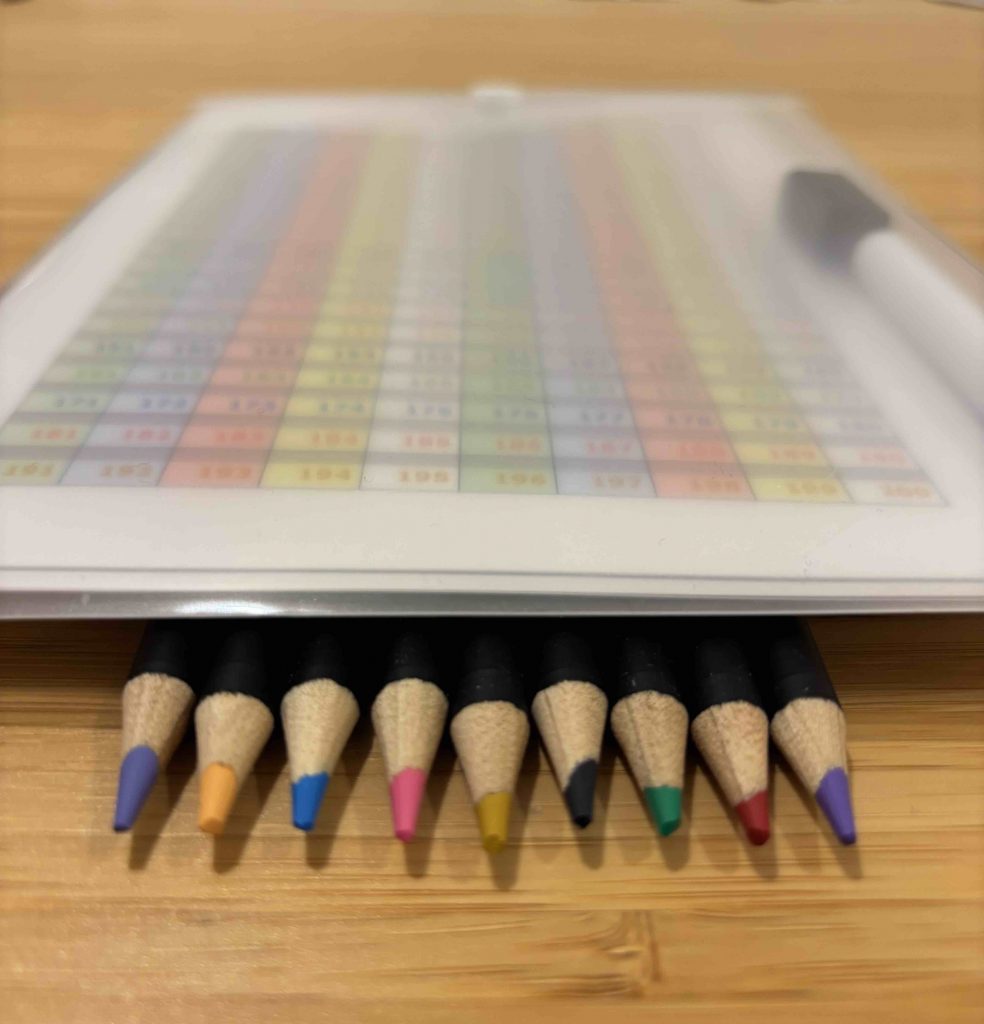
A visual, colour-coded table that helps children understand number relationships at a glance.
Its simple layout supports alignment, reduces working-memory load, and makes addition and subtraction clearer and more predictable — both at school and at home.
COMtable is not designed to replace thinking, but to support it —
keeping children actively engaged in the process of calculation.
COMtable is not just a learning aid. It’s a structured system for understanding mental maths.
Instead of relying on memorised steps, children work with visual patterns and a consistent structure — making number relationships clearer, more predictable, and easier to follow.
The goal is not to do maths faster. It’s to support real understanding, while keeping children fully engaged in thinking, reasoning, and calculating.
Rethinking the role of the calculator
A calculator is an essential tool for many students with learning difficulties. They learn to use it for what it does best: supporting problem-solving, checking the correctness of a strategy, and allowing them to focus on the reasoning rather than the mechanics of calculation. But in the early years — when children are still building their number sense — mental strategies matter far more than speed. A calculator can give the answer instantly, but it bypasses the very thinking processes that help children recognise patterns, plan steps, and understand how numbers relate to each other. This is why practising without a calculator remains a key goal. It gives all children, including those with dyslexia, the opportunity to work like the rest of the class: exploring strategies, noticing patterns, and developing a flexible, reliable sense of number. Later, when operations become a tool inside a larger problem, the calculator becomes an excellent ally. But in the years when children are learning the facts and building the foundations of mental calculation, tools like COMtable provide something the calculator cannot: active thinking, meaningful practice, and cognitive engagement. That’s what truly builds confidence, and what lasts over time.
The number that slipped away
A story about short-term memory, frustration, and the moment everything finally made sense.
Jack is a bright, curious, and chatty boy, the kind of child who asks clever questions and notices things others miss.
But the moment the teacher says, “Let’s do a quick mental calculation,” something inside him tightens.
Today the question is simple:
46 + 27
Around him, hands shoot up.
A friend whispers the answer under his breath.
The teacher waits.
Jack starts well:
6 + 7 = 13.
He knows this. He feels proud.
“Okay,” he thinks to himself, “I’ll remember the 1… don’t lose it… now the tens: 40 + 20 = 60… okay… now I need that 1 again… where is it?”
And suddenly, it’s gone.
It’s as if the number has slipped off a small table inside his mind.
He tries to rebuild the steps quickly, but the more he tries, the more everything blurs.
Someone at the back already has the answer.
The teacher gently encourages him:
“Take your time, Jack.”
But “taking time” is the problem.
Every extra second increases the pressure, and with pressure, the small mental whiteboard where numbers should sit becomes even smaller.
He says “63”.
It’s wrong.
He knew it before he said it.
Jack isn’t bad at maths.
He understands the logic of addition perfectly.
What he doesn’t have (or rather, what doesn’t work reliably for him) is the short-term memory space needed to keep track of the intermediate steps.
And this doesn’t happen only during maths:
- copying from the board,
- remembering multi-step instructions,
- holding a sentence in mind before writing it,
- staying focused during tests…
Short-term memory affects everything.
But maths makes it more visible, because when one tiny piece of information is lost, the whole operation collapses.
Jack watches his classmates finishing quickly, and feels slow.
He thinks:
“Why am I the only one struggling? What’s wrong with me?”
Nothing is wrong with him, of course!
His mind just works differently.
And what he needs is not pressure, or extra drilling, but a way to make the hidden steps visible, so he doesn’t have to hold them all in his mind at once.
That’s where tools like COMtable change the story.
Instead of relying on a fragile mental whiteboard, the steps sit clearly on the table:
- the carried digit,
- the intermediate result,
- the structure of the number,
- the path from start to finish.
Suddenly, Jack can see his thinking.
And when he can see it, he can trust it.
The frustration drops.
The sense of competence grows.
And slowly, the story he tells himself changes from:
“I can’t do this.”
to
“Can I try another one?”

Why it works
Through its colour-coded structure, COMtable makes number patterns immediately visible, helping children anchor the intermediate steps of a mental calculation on the table — instead of storing everything in working memory.
This reduces cognitive load and builds confidence, while reinforcing essential mental-math skills like number composition and decomposition.

Who is it for?
Created originally for dyslexic students aged 6–10, COMtable is equally helpful for any child who struggles with number alignment, place value, or remembering the intermediate steps of a calculation.
By supporting weak working memory, it helps pupils follow the correct order of operations — both in mental maths and in written column calculations — reducing confusion while strengthening core mathematical strategies.

Try it in class or at home
Specifically designed for addition and subtraction, COMtable is simple to introduce in both one-to-one and small-group settings.
You can use it to explore number patterns, guide pupils as they break a calculation into steps, or practise quick “Make 20” and bridging strategies. Its visual layout helps children stay focused and engaged, while strengthening the reasoning behind each choice they make.

Discover how to use it
With the erasable pen, children can actively trace the start, mid and end points of any calculation.
The laminated surface lets them write, check, correct and try again — keeping track of each step directly on the table.
By marking intermediate values instead of holding them in mind, pupils stay focused on the strategy and find even multi-step additions and subtractions easier to follow.
Thanks to a small colour-guided card, they naturally learn to line up units, tens and hundreds with clarity and consistency.

What’s included in the set
The COMtable set comes in a sturdy, waterproof button-folder, ideal for classroom or home use. Inside, children receive the laminated table, an erasable pen, a short guide with examples, and a double-sided practice card — with a colour-guided alignment layout on one side and open graph space on the other for free exercises and quick notes.
The folder also includes a QR code that gives you access to a dedicated page with guided exercises, step-by-step examples, and practical ideas for using the COMtable effectively at home or in class.