A Simple Strategy, A Huge Difference
A story about structure, maths, and how thinking becomes visible.
⏱ 5 min read · 🎧 Audio available soon · 🛠️ Related tool
Sometimes a very small structural change can significantly transform the outcome of a task.
Not because the student suddenly “gets better”, but because the task becomes clearer, more manageable, and easier to control.
The story below describes an exercise that looks simple at first glance, but that, step by step, involves many different processes.
This makes the story inevitably longer, especially if we want to understand the reasons behind what happens.
It also opens the door to deeper reflections on aspects of dyslexia that are not always immediately visible, and that will be explored separately in dedicated articles.
The Impossible Expression
Helen is one of those students who actually likes maths. She studies, she pays attention, she understands the rules.
That said, maths sometimes plays tricks on her. There are moments when things don’t go as smoothly as she expects.
Right now, at school, she’s working on algebraic expressions. The long ones, with brackets inside brackets and several operations on the same line. And this is where things start to get complicated.
Not because she doesn’t understand what to do. Helen knows the rules of precedence perfectly well. She knows that brackets come first, and that some brackets come before others. She knows how addition, subtraction, multiplication, and division fit into that order. She knows how to move from the inside out. If you asked her to explain it out loud, she could.
So she starts by writing the full expression at the top of the page.
Her handwriting is large and very irregular. It always has been. The line starts straight, then slowly tilts upward. Halfway through, there’s no more space, so she continues on the next line.
Then, the real work begins.
Now she has to do several things at the same time. She has to look back at the line above, decide what needs to be calculated and what needs to be copied, then write it again below. Her eyes move up and down quickly, because there isn’t much time.
In that tiny moment, when her eyes jump from one line to the next, she has to decide what stays and what changes, what belongs to this step, and what needs to wait.
She writes fast.
The numbers are uneven. Some lean. Some are too close together. The lines become more and more slanted. The rush doesn’t help.
She keeps going. She finishes the expression. She gets a result.
And she already knows it’s wrong.
The book gives a different answer, so she does what any serious student would do. She goes back to check.
She starts again from the beginning, because that’s where things should still make sense. She follows the expression step by step, trying to recognise her own work.
But at some point, the page stops helping her.
She looks at a line and wonders whether it was copied or calculated, which bracket was still open at that point, whether a number came from the line above or from an earlier step.
Some digits don’t feel reliable anymore. She doesn’t quite recognise her own writing. A seventy-eight could easily be a forty-eight now, and if that happened, it happened earlier, when she was writing fast.
There’s no way to recover the original number.
What she wrote no longer tells her what she meant.
The mistake could be anywhere: near the beginning, in the middle, or in a number copied too quickly. Finding it would mean redoing everything, slowly, from the start.
She exhales. Then she draws a thick line across the page. Sometimes it turns into a big dark scribble.
And then she starts all over again.
This is the point where many students stop trusting themselves.
A Green Pencil
One afternoon, Helen is suggested to try something different.
Not a new app. Not a calculator. Just a different way of using the page, one that supports her work without changing expectations or assessment.
She’s given a lined notebook instead of squared paper. Every three lines, she puts a small dot at the beginning: one line yes, two lines no. Just enough to create a visual rhythm, something to anchor herself to. Before long, this helps her reclaim the space on the page, and her writing begins to stay straight.
Then she’s given a green pencil.
Before calculating anything, she looks at the expression and marks, in green, the operations she knows must be carried out on the next line.
On the next line, she copies everything up to that green mark. Copying is easier now. The lines guide her writing.
She stops at the green sign, does the calculation, and continues to the end of the line. Then she begins again, analysing the line she has just written and marking, in green, the operations that now come first. She keeps going this way, step by step, until she reaches the result.
This is not a personalised solution. It’s a structural one.
She finishes the expression. The result is right. And even if it weren’t, she could find the mistake, because now her work has a structure, a path she can follow, a place where each decision was made.
Now the page can hold her thinking.
It’s a very small change, but the effect is huge.
Helen didn’t learn new maths that afternoon. She simply found a way to make her thinking visible, step by step.
And that makes all the difference.
From chaos to control
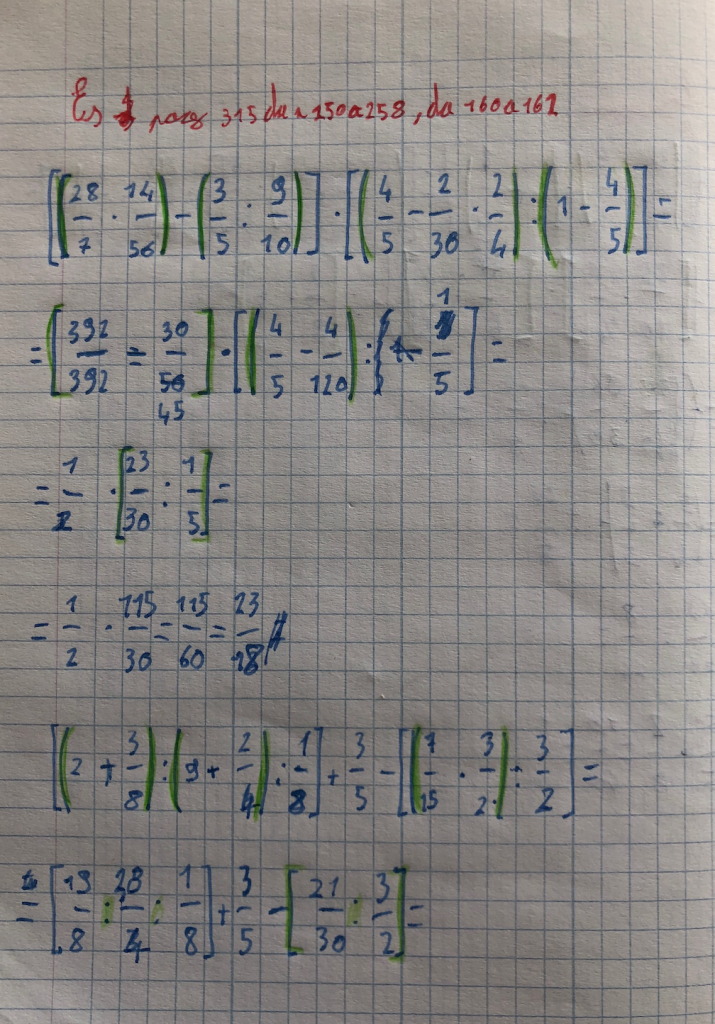
– Before structure
Before any strategy is introduced.
The result is wrong, and the path is no longer readable.
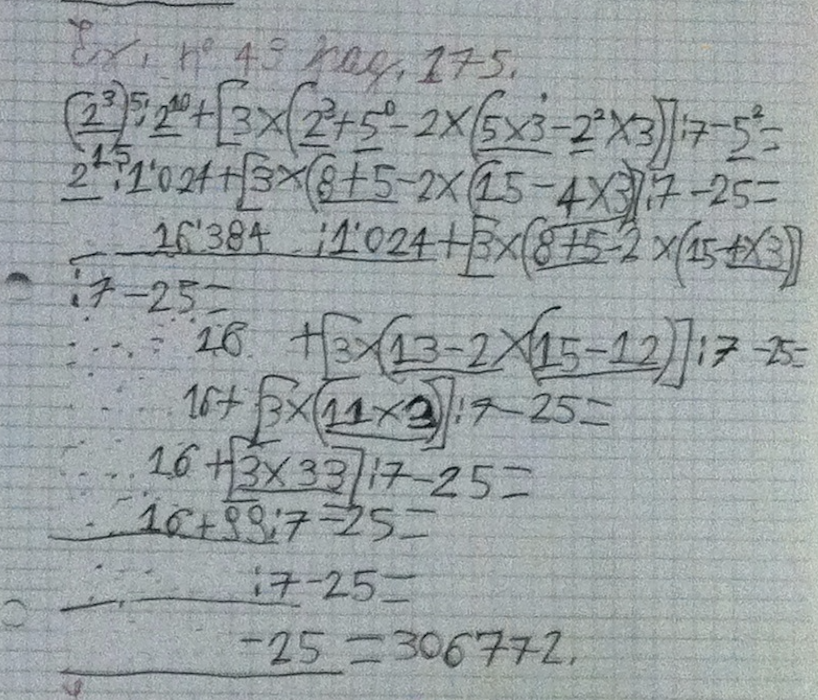
– Introducing the green pencil and lined paper
The green pencil is used to mark what needs to be dealt with next.
Lined paper helps keep the work aligned, and the steps are no longer lost.
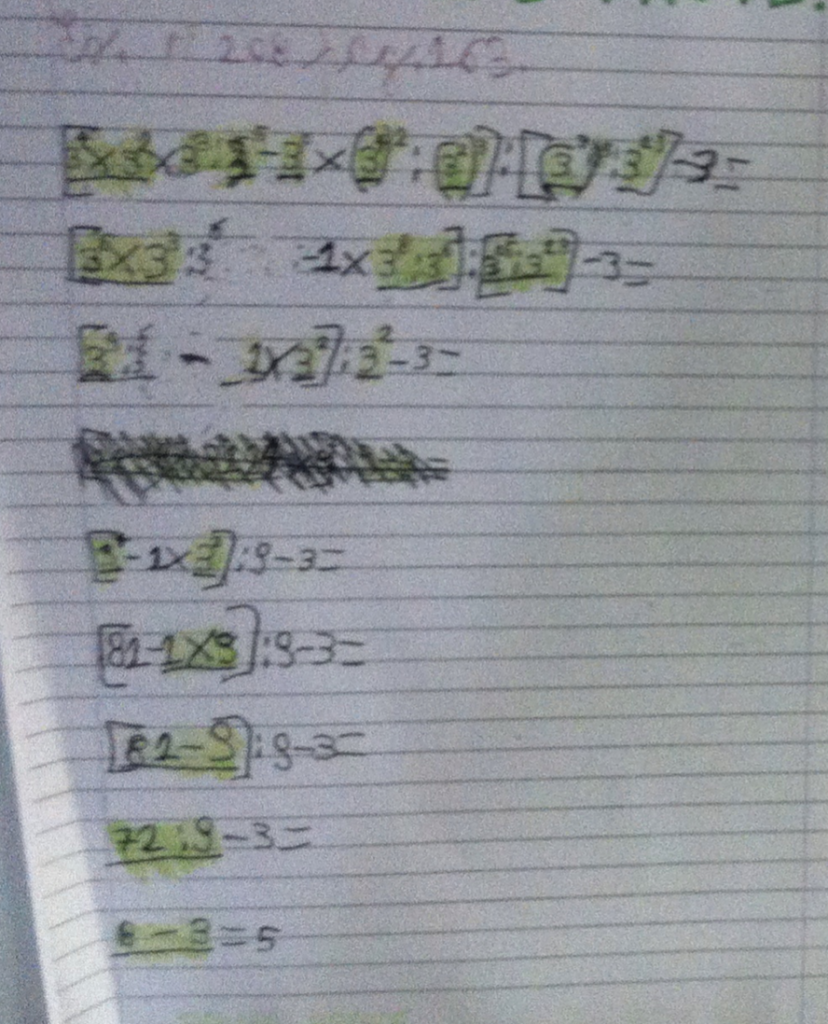
– Familiarity and accuracy
With practice, the method becomes familiar.
The calculations are accurate, and the work is easier to follow.
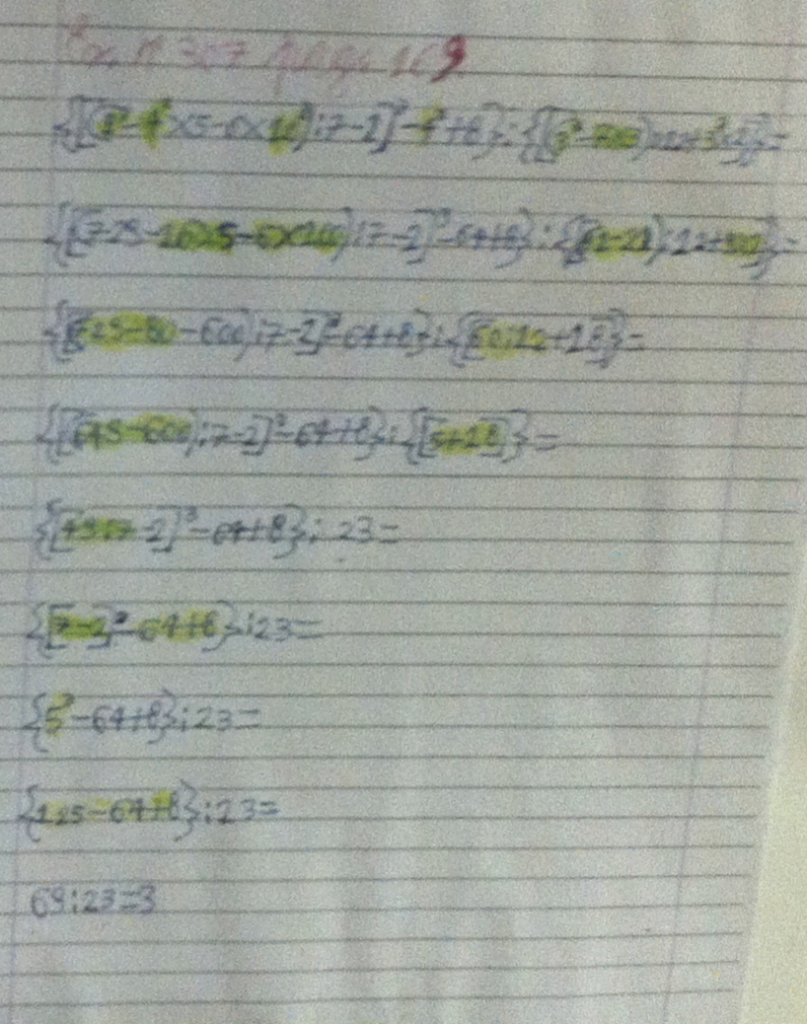
– Returning to squared paper
Once the structure is internalised, the student can return to squared paper,
with precision and confidence.